Tantric Meditation: The Space Where the Divine Awakens
Dec 24, 2025
Tantric meditation is the practice of awakening consciousness through the body. It is the art of becoming fully present within your own physical and energetic experience, allowing awareness and life-force to move together as one unified flow.
At its essence, Tantra teaches that life itself is sacred. Everything carries the potential to awaken us. Tantric meditation is the method that makes this recognition experiential. Through it, you learn to inhabit your body as a living temple of awareness.
Tantra as a life approach which, through methods of meditation, offers an alchemical transformation of each aspect of our being. This means that meditation, in the Tantric sense, is not about withdrawing from life but entering it more deeply.
Where many forms of meditation seek to still the mind by retreating from the senses, Tantric meditation brings consciousness into the senses, into the rhythm of the breath, and into the flow of energy that moves through the spine. This path honors the physical body as the doorway to higher awareness.
The Essence of Tantra Meditation

In the Tantric view, nothing is impure. The body, breath, emotion, and desire are all waves of the same current of energy, the sacred Shakti that animates all life. To meditate in the Tantric way is to welcome every sensation, every feeling, every movement of energy as part of awakening.
The roots of Tantric meditation lie in the Vigyan Bhairav Tantra, a dialogue between Shiva and Shakti that describes one hundred and twelve techniques for awakening consciousness through sensory experience. Osho’s modern commentary on this text, The Book of Secrets, talks about these methods as ways to bring meditation into life, not life into meditation. Many misconceive Tantra as sexual rituals, but that is not what Tantra is focused on. Tantra is actually focused on bringing a meditative awareness into each and every life experience.
Tantric meditation is a spiritual practice that can be practiced alone or with a partner. In solo practice, awareness turns inward, and the breath becomes the lover, the body the beloved. In partnered practice, the same principles expand outward into relationship; the other becomes a mirror of consciousness, a field where breath, awareness and touch merge into a shared meditation.
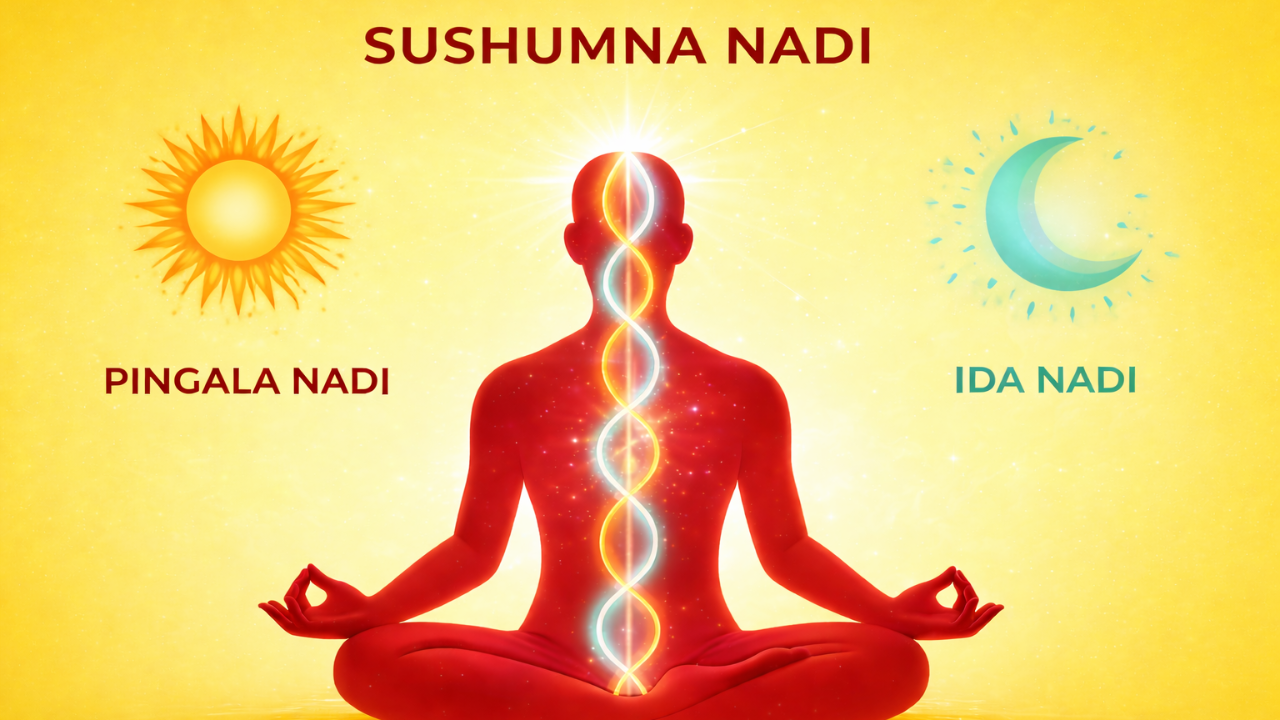
At the heart of this transformation lies the awakening of Kundalini, the coiled current of creative life force that rests at the base of the spine. As meditation deepens, this energy begins to uncoil and ascend through the Sushumna Nadi, the central channel that links the pelvic root to the crown of the head. When this pathway clears, the body becomes radiant; the nervous system reorganizes itself to carry higher frequencies of awareness. This eventually becomes a stream of inner ecstasy moving upward into to crown chakra. This is known as the rising of Kundalini energy, the great serpent opening new levels of bliss and consciousness.
The Meaning of This Ancient Practice
The word Tantra comes from two Sanskrit roots, tan, meaning “to expand,” and tra, meaning “instrument” or “method.” Tantra, therefore, means methods for expansion of consciousness.
Tantra teaches that the divine is not separate from the material world. Every moment, every breath, every sensation, and even our sexual energy is an expression of the same consciousness unfolding in different forms. Nothing is excluded; nothing needs to be rejected. To live fully and consciously is to participate in the sacred.
The early Tantrics observed that within every human being flows the life-force current, called prana or Shakti. This current is the animating power behind all movement, growth, and awareness. It is the pulse of existence within the body. When this energy moves freely, there is clarity, vitality, and a natural sense of connection with all life. When it becomes stagnant, confusion and separation arise.
The Philosophy - From Separation to Union

At the heart of Tantric meditation lies a profound truth that existence is made of two forces, Shiva and Shakti, consciousness and energy, stillness and movement. These are not deities to be worshipped externally but living principles that exist within every being. Shiva is the witnessing awareness, the silent, unmoving center of all things. Shakti is the pulse of creation, the life force that animates everything.
Tantra teaches that spirit and matter are lovers longing to be reunited. This is the essential philosophy that underlies all Tantric meditation. To meditate in the Tantric way is to embrace the opposites, light and shadow, joy and pain, masculine and feminine, action and surrender. In the heat of their meeting, awareness is born.
As Osho teaches, when love and meditation meet, a new wholeness is born, love without awareness becomes blind, and meditation without love becomes dry.
In the Tantric view, every human being carries both Shiva and Shakti within. When these forces are divided, we experience confusion and longing. When they are harmonized, a state of inner union arises, a quiet ecstasy where doing and being, effort and ease, dissolve into one flow of consciousness.
This is the inner marriage. When we allow the masculine and feminine to meet in meditation and when awareness penetrates energy and energy surrenders into awareness, a new state of being emerges, one of divine presence. This is the hidden meaning of the sacred symbol of Shiva in union with Shakti, known in Sanskrit as Yab-Yum, the perfect balance of consciousness and life force.
In this state of unity, meditation ceases to be something we do. It becomes something we are. The breath moves on its own; awareness shines without effort. Every sensation, thought, or emotion becomes a pulse in the divine rhythm of existence.
1. Bio-Resonance Meditation
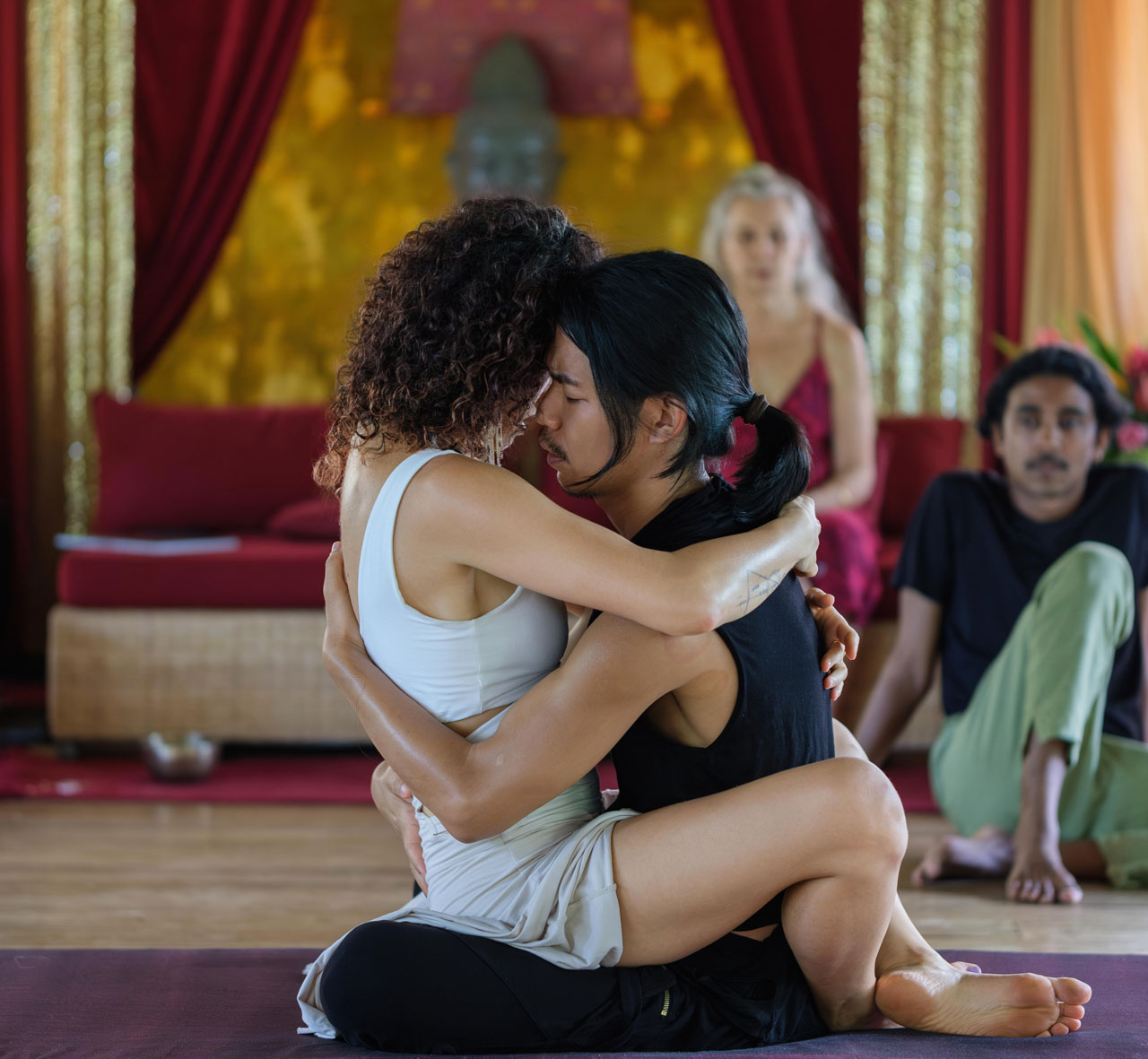
The Bio-Resonance Meditation, (created by Sarita) is a sacred attunement between two beings for harmonizing the body’s subtle bio-electrical fields until two heartbeats and two energy currents begin to vibrate as one. In this meditation, partners enter a shared field of resonance through breath, sound, and touch.
Tantrically, this resonance opens the Sushumna Nadi, the central channel through which life-force ascends. The circular breathing between the Lingam and Yoni, and the heart, activates and harmonises the masculine and feminine poles, becoming a sacred circuit of energy. Each inhale draws awareness inward; each exhale radiates love outward. Over time, the individual sense of “me” and “you” gives way to a shared consciousness that is neither male nor female, but the living dance of Shiva and Shakti.
How to Practice
- Phase 1 (10 min): Sit opposite your partner, palms touching, fingers resting lightly on each other’s wrists. With eyes closed, breathe naturally and witness your breath, thoughts, and feelings. This simple contact balances the bio-electricity within and between your bodies.
- Phase 2 (1 1/2 min): Each places the middle finger of the right hand on the partner’s heart chakra to create a field of heart resonance.
- Phase 3 ( 1 1/2min): Each places the middle finger on the partner’s third-eye center between the eyebrows, awakening intuitive connection.
- Phase 4 (10 min): With palms again touching, hum together. The vibration activates the crown chakra and the central channel (Sushumna Nadi).
- Phase 5 (10 min): Take turns to touch your partner’s body from head to feet lovingly and firmly, then caress the aura around it. The receiver remains silent, eyes closed.
- Phase 6 (10 min): Optionally remain seated or move into Yab-Yum. Begin circular breathing: the man breathes out through his Lingam as the woman inhales through her Yoni and breathes out through her heart; the man then inhales through his heart, exhales through his Lingam. After five minutes, reverse the flow.
- Phase 7: End by bowing in Namaste, crown chakras touching, to express gratitude.

2. Embracing Meditation Practice
The Embracing Meditation (from Sarita’s book Tantra Alchemy) is an intimate merging of energy fields that dissolves the illusion of separation between two beings. In this meditation, partners come together in a gentle seated embrace, such as in the Yab-Yum posture, where one sits in the other’s lap, or in the softer Lover’s Embrace, with bodies simply holding each other.
As the partners synchronize their breathing, the boundary between self and other begins to dissolve. With every inhale, the awareness expands; with every exhale, the body relaxes into the shared field. Within it, the subtle currents of Shakti (energy) and Shiva (awareness) begin to circulate naturally between the lovers. The entire aura becomes a shared vessel — a container of meditation.
How to Practice
- Sit together in Yab Yum, Woman’s Delight, or Lovers’ Embrace posture. The Lingam may be inside the Yoni or not, movement is secondary to presence.
- Remain silent and synchronize your breathing. At the top and bottom of each breath, pause briefly, bringing awareness to the still point between inhalation and exhalation.
- If in Woman’s Delight, the man rests his hand lightly for two minutes on each of the woman’s chakras in sequence, yoni, belly, solar plexus, heart, throat, third eye, crown.
- Continue breathing together for about 20 minutes. You may remain in meditation or move naturally into lovemaking and tantric sex.
3. Caressing Meditation
The Caressing Meditation is from the Vigyan Bhairav Tantra. It is designed to awaken the entire body’s sensitivity. In this meditation, one partner becomes the receiver, lying naked and still, while the other takes the role of the giver, channeling awareness through their fingertips. Using only one hand at a time, the giver gently caresses the receiver’s body from head to toe in slow, smooth, unhurried movements that trace the contours of the skin like waves upon the shore.
The receiver remains silent, eyes closed, surrendering to the touch and focusing only on the present moment, the sensation of being touched as a meditation in itself.
After ten minutes, the receiver turns over, and the giver continues to caress the front of the body in the same slow rhythm. When the meditation is complete, the giver sits quietly beside their partner, leaving space for stillness and integration. This is based on a Vigyan Bhairav Sutra:
“While being caressed, Sweet Princess,
enter the caress as everlasting life.”
How to Practice
- The receiver lies naked on the front; the giver sits beside and caresses from head to toe using slow, continuous fingertip strokes, light but not ticklish.
- After 10 minutes, the receiver turns onto the back; repeat the caress for another 10 minutes.
- Throughout, the receiver remains silent, focused on sensation in the present moment.
- The giver may softly recite the Shiva Sutra: “While being caressed, Sweet Princess, enter the caress as everlasting life.”
- Afterward, sit quietly together for a few minutes, allowing energy to integrate before exchanging roles.
4. Looking with the Eyes of Love

In Tantra, the eyes are the living extensions of the heart, direct channels through which awareness and love flow. To look with the eyes of love is to see and be seen without any filter, to allow your gaze to become a bridge between two souls.
This meditation can be practiced with a beloved, a friend, or alone in front of a mirror. This can also be done during lovemaking. The gaze is an act of surrender, a willingness to let the mind fall silent so that the heart may perceive.
The ancient source of this meditation is found in the Vigyan Bhairav Tantra. In the sutra that inspired this practice, Shiva says: “Look lovingly at some object. Do not go on to another object. Here in the middle of this object, the blessing.” Normally, our gaze is restless, moving from one thing to another, clouded by judgment and desire. But when the eyes rest on one point with love, the outer form and the inner witness slowly merge. The object disappears, the observer disappears, and what remains is the pure seeing itself, Bhairava, consciousness without division.
How to Practice
Sit facing your partner, looking into each other’s eyes, for about 10 minutes. Simply receive your partner’s look. This way of seeing is called Yin vision. It creates receptivity, and opens right brain function. When the right brain is activated it enhances feelings of love, and when love is present you will discover the blessings inherent in what you are seeing.
To practice this alone, look into your own eyes in a mirror for about 5 minutes. This is Yang or outward vision. Then allow the eyes in the mirror to look into you for a further 5 minutes, using Yin or receptive vision. Next look at a tree or a flower for 10 minutes. Then allow the tree or flower to look into you for 10 minutes.

5. Three-Minute Laughing Meditation
This meditation has been created by Osho. In Tantra, laughter is medicine. It is a spontaneous pulse of life that shakes loose the heaviness of the mind and lets energy flow freely again. It is the most effortless of all meditations. Osho revived this ancient method as part of his series of active meditations Through laughter, he said, the body returns to innocence and the soul remembers its natural rhythm of joy. As Osho said, “Laughter is the sound of freedom.”
Some Tibetan monks use this method in their monasteries and it is a great way to start the day. Since laughter enhances your immune function, it is very good for health and longevity. It will also help to make you more orgasmic. Laughter transforms your life, helping you to transcend illusions and to come close to the source of creation, the cosmic joke in which we are all participants.
Use this meditation every morning for 21 days to experience its full impact on your life.
How to Practice
When you wake up in the morning, before you open your eyes, spend one minute stretching like a cat, allowing your whole body to give a great yawn. Then, laugh from your belly, moving into a whole body experience. Laugh loudly for three minutes. Open your eyes and begin your day.
6. The Dance of Shiva (Nataraj Meditation)
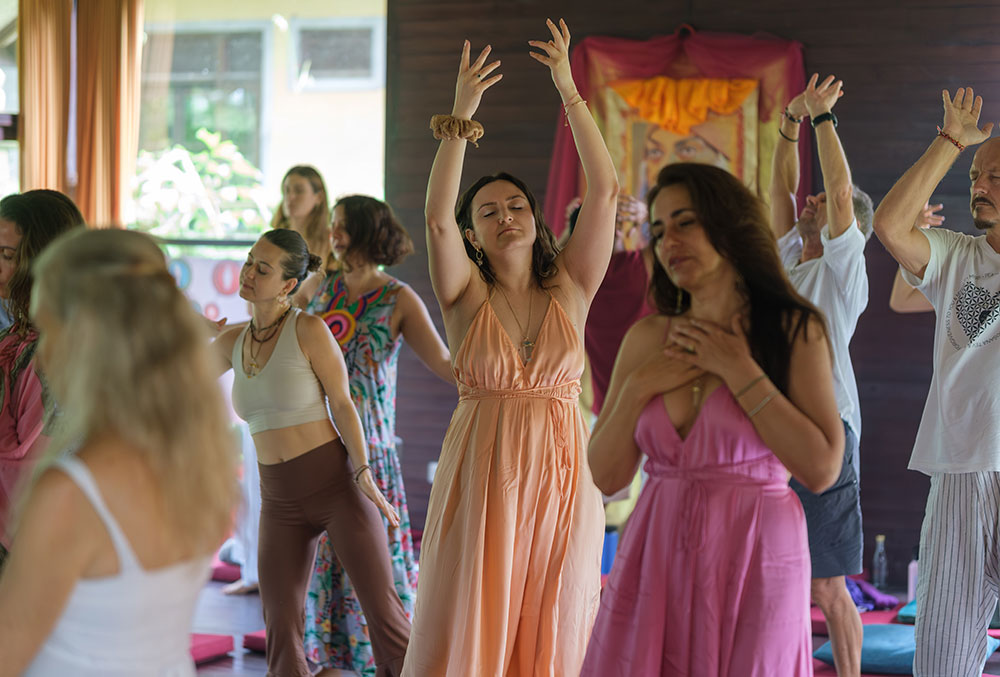
The Nataraj Meditation is one of Osho’s most powerful active meditations and an embodiment of the Tantric truth that movement and stillness are not opposites, but reflections of one another. In Sanskrit, Nataraj means “Lord of the Dance,” the form of Shiva that symbolizes the universe in perpetual creation and dissolution.
Osho designed this practice to awaken energy first through movement and expression, then through silence and witnessing, and finally through celebration and gratitude. As the dance deepens, the distinction between “you” and “the dance” begins to dissolve. As Osho says: “The dancer disappears; only the dance remains.” After forty minutes of this free, total dancing, the second phase begins, which is laying down on your back in stillness.
The body continues to vibrate with the energy you have awakened, but now you are only the witness. This is the moment when Shakti returns to Shiva, when the energy of movement merges with the awareness of stillness. Your breathing slows, thoughts fade, and a vast silence fills the inner space.
Practiced regularly, it creates the direct experience of Shiva consciousness, which is awareness untouched by the fluctuations of the mind.
Osho describes the essence of this meditation:
“Dance so totally that the dancer disappears and only the dance remains. Then you will know what meditation is.”
How to Practice
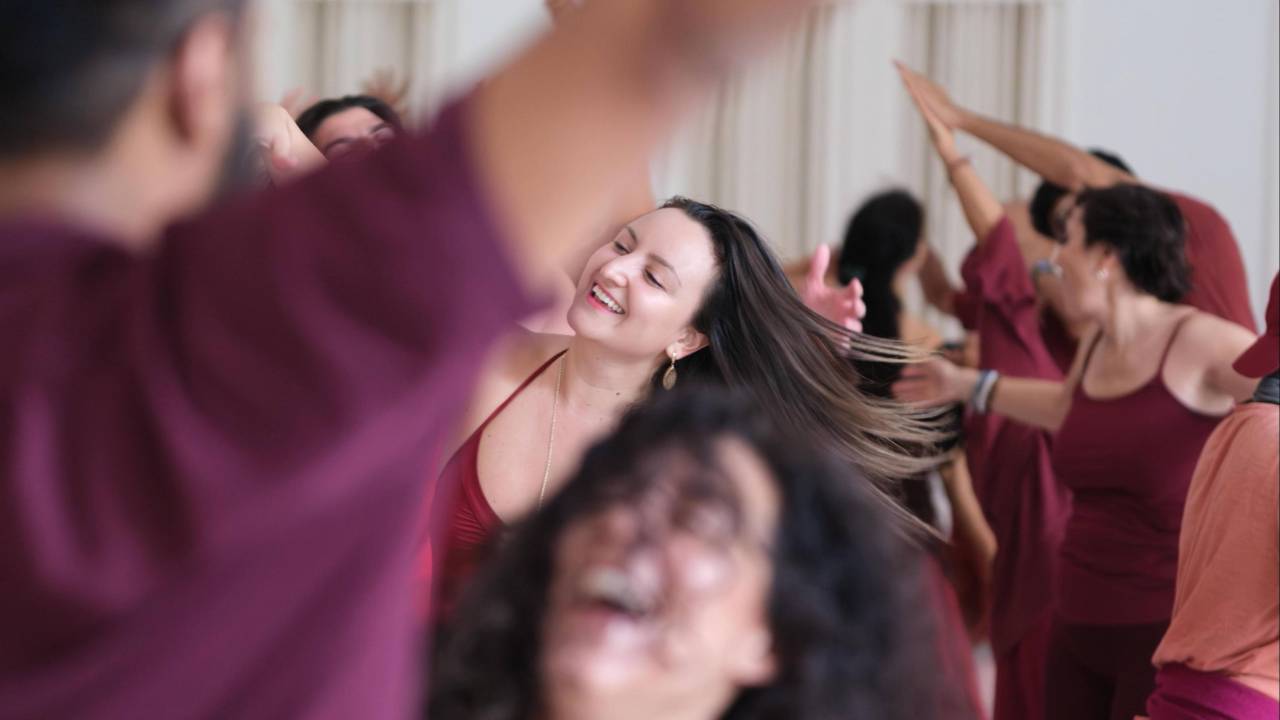
Yang phase: Dance ecstatically for 40 minutes. Become the Shiva Linga, dancing the stars, the sun and the moon, the trees and the plants, the mountains and the sky, and the animals. Become one with the power that creates the whole of life.
Yin phase: Lie down for 15 minutes in complete stillness and let go. Get up and dance again softly for 3 minutes, bringing integration.
Always use the music created especially for this meditation.
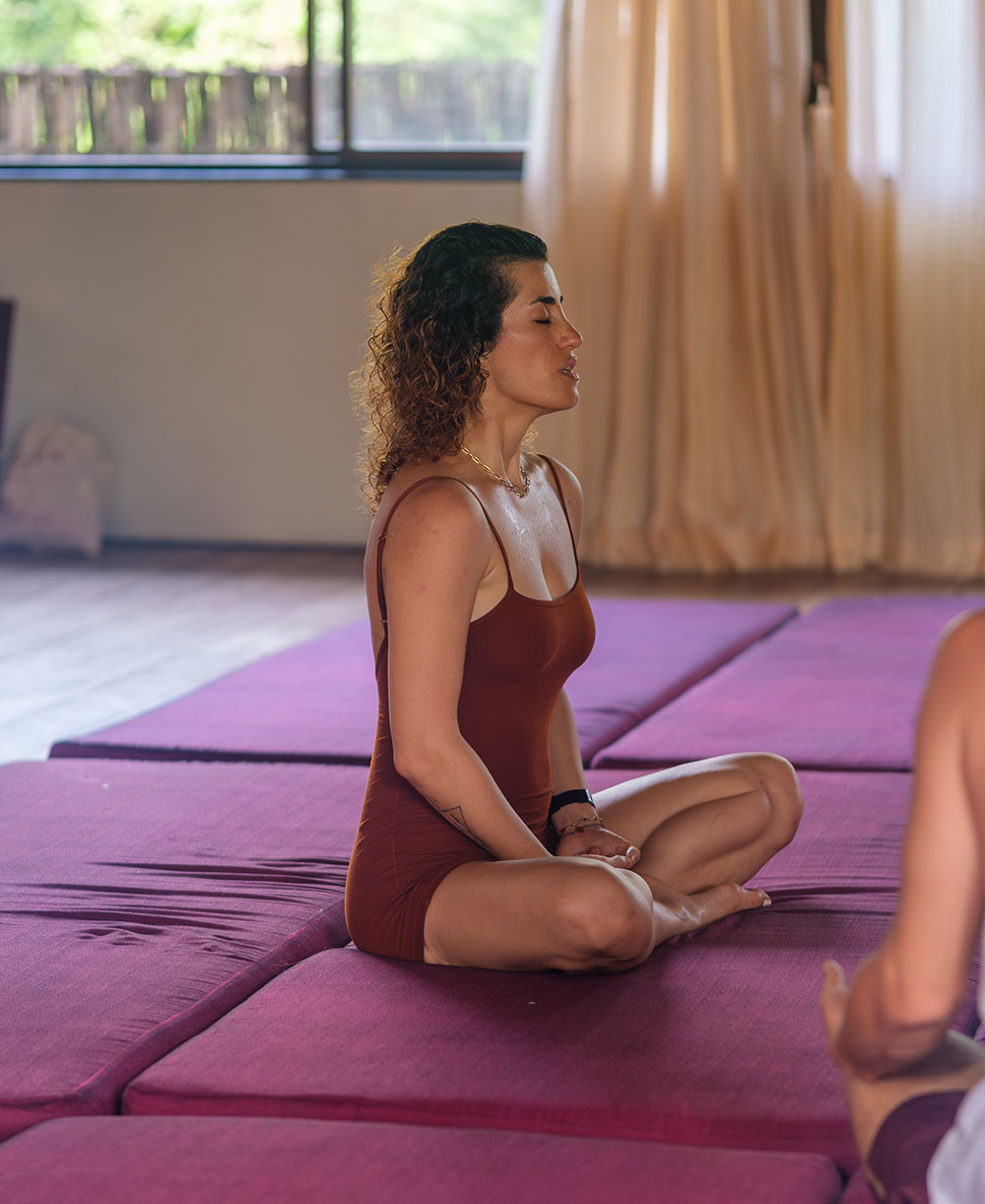
The Feminine Path of Awakening
Within the Tantric tradition, women are considered direct embodiments of Shakti. Where masculine meditation often emphasizes stillness, female Tantric meditation begins with sensation, movement, and expression.
In Sanskrit, Shakti means power, creative force, divine feminine energy. Every Tantric practice for women is designed to awaken this current. When Shakti rises, it animates every cell of the body with awareness and it also does this through the breasts, womb, and Yoni. These are literal energetic centers through which consciousness expresses itself.
Breast Meditations - Opening the Heart Channel
Several practices from the Vigyan Bhairav Tantra and Osho’s commentaries focus on the breasts as portals of Shakti. In these meditations, the woman places her hands over her breasts and breathes slowly into them, feeling warmth spread beneath her palms. The inhale draws energy up from the pelvis; the exhale releases it through the heart.
This simple act of breathing into the breasts awakens the Anahata chakra, the heart center, dissolving emotional armor and cultivating unconditional love. This is the flowering of the upper lotus. Once the breasts awaken, they become conductors between the deep earth energy of the pelvis and the expansive sky energy of the crown.
Energetically, the breasts are considered the giving poles of the feminine body and they radiate the nourishment that the Yoni receives. In Tantric physiology, the female body operates through a descending and ascending spiral where energy is gathered through the Yoni, rises through the womb to the heart (breasts), and then flows to the crown, where it meets pure awareness. When this circuit is complete, a woman experiences an inner orgasm of consciousness.
Osho described this state as the Shakti awakening, when the whole body becomes a temple vibrating with divine electricity.
In our Online Programs for women, we work with various breast meditations and practices that focus on the feminine path to awakening.
The Masculine Path of Awakening
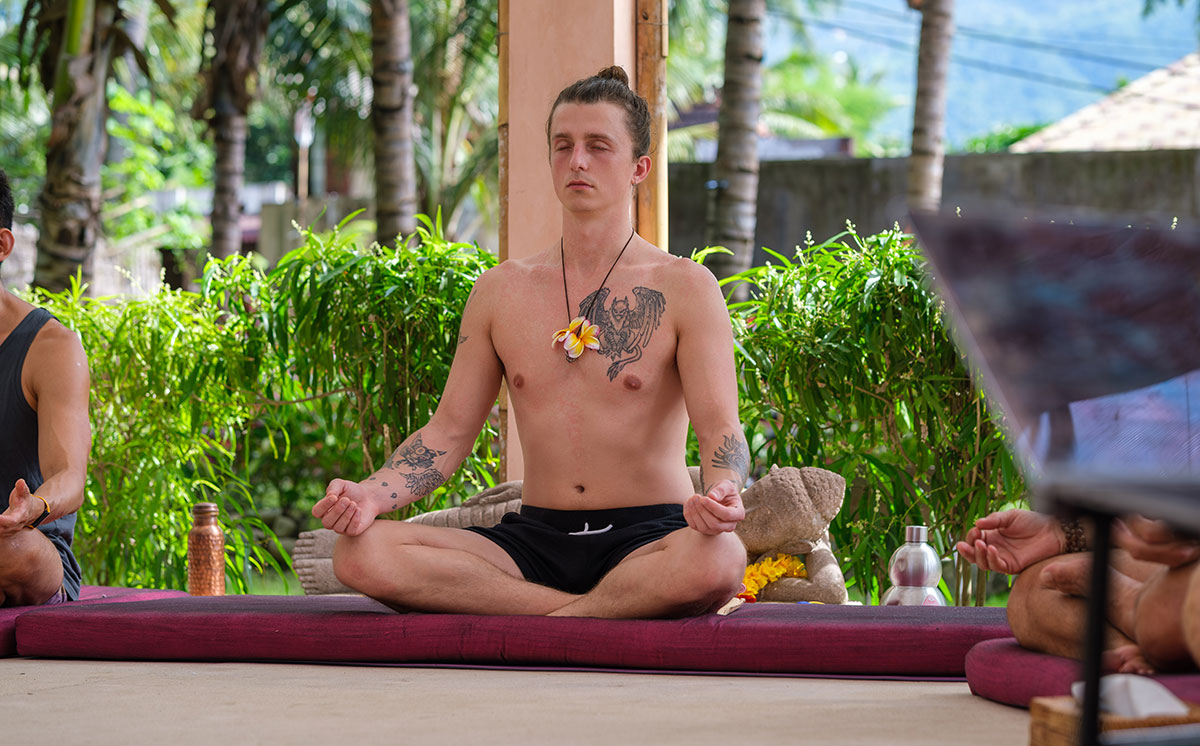
Where the feminine current of Tantra flows upward from the depths of the Yoni to the heart, the masculine current begins with grounding and descends into stillness. It is the path of Shiva, the silent witness, the unshakable mountain of awareness that gives form and direction to energy.
In Tantric philosophy, every man carries both Shiva and Shakti within. His evolution begins when he learns to awaken the root energy (Muladhara) and refine it into conscious power.
The base of the spine and the genitals are the masculine centers of strength. When this center is neglected or repressed, a man becomes scattered or anxious; when it is overstimulated, he becomes restless or compulsive. The goal of male Tantric meditation is to channel vitality upward through awareness rather than dispersing it unconsciously.
1. The Root Lock (Mula Bandha)
The classical practice of gently contracting the pelvic floor while breathing slowly through the nose.
- Inhale and lift the energy upward from the perineum toward the navel.
- Exhale and relax completely. This strengthens the root and teaches the practitioner to guide arousal into awareness instead of outward release.
Read: Bandhas 101: An Introduction to Yoga’s Energy Locks
2. The Fire Breath of Shiva
Derived from the Vigyan Bhairav Tantra, this breathwork trains a man to stay conscious within intensity.
- Sit upright, spine straight.
- Inhale through the nose into the belly; feel heat gather at the base.
- Exhale through the mouth with a slow sound, letting energy rise to the heart.
- At the top of the breath, rest briefly in stillness.
3. Conscious Retention and Circulation
Osho often emphasized that ejaculation is not wrong, but unconscious discharge wastes spiritual fuel. By remaining aware during peak arousal a man learns to circulate the current through the spine and the heart. The pleasure expands instead of ending; awareness remains luminous and steady. Retention becomes revelation. When energy no longer escapes outward, it flowers inward as light.
4. Standing Like a Mountain
A grounding meditation for men is standing with feet hip-width apart, knees soft, eyes closed. Feel the soles of the feet rooting into the earth. Breathe down into the pelvis and up through the crown. As the breath deepens, the whole body becomes a vertical axis between earth and sky.
This practice awakens the Shiva principle of steadiness, that calm strength that can meet any wave of emotion or desire without losing center.
Conclusion
True Tantric meditation reveals that the beloved you seek has never been outside of you. It is the witness behind every thought, the pulse of awareness within your very flesh.
When you merge breath, body, and consciousness, you become the living dance of Shiva and Shakti, consciousness and energy intertwined in perfect harmony. There is no separation left between the sacred and the ordinary.
In this space, love is what you are. You are the divine, remembering itself through you.
Authors